terça-feira, 27 de março de 2012

Sturmtiger in action! - by Mário Laranja


Check out ML new project, fresh from the drawing board!

A brand new Sturmtiger!


I know for a fact that ML was worried about CB's latest modelling output, and he wanted to show the world that he could also pull one of two rabbits from his (modelling..) hat.


This assault gun (a.k.a. Sturmmörserwagen 606/4 with a 380 mm RW 61 rocket launcher) was meant to be the answer to well fortified redoubts held by infantry, mainly in urban warfare.

It's 380 mm rocket launcher could easily level almost any building in sight.


And check out where the Sturmtiger is parked: a brand new village!


Well, maybe this village will not remain "new" for long, if Sturmie over there starts delivering it's ordenannce around...


This is another great piece of modelling ML - congratulations!


BT

quarta-feira, 21 de março de 2012

WWII Locomotives & War Series nº 40 - by Carlos Briz


(class FS650 locomotive - Italian State Railways)

This is the biggest one yet!

Check out how you can place a Giant and a Locomotive in the same dio and get a fine result!


The Messerschmidt Me 323 was the largest transport aircraft of WWII, and was able to haul up to 20 tons of hardware.


During the North Africa campaign the Germans tried several times to bring supplies using these monsters, but more often than not they became easy prey for the RAF

Another great dio CB!

BT

segunda-feira, 19 de março de 2012

SCW & Locomotives - by Carlos Briz


(Class 4021 locomotive - Madrid-Zaragoza-Alicante Railways)

Check this out: CB brings us two more outstanding dios, related to the Spanish Civil War!

I guess this is one of the favourite historic periods with CB, since he keeps bringing wonderful stuff related to it.

By the way CB, if you really like this war that much, be sure to read Hemingway's "For whom the bell tolls" - it's a satisfaction garanteed historical novel!


The Heinkel He 115 seaplane was used as a torpedo bomber, but it's best performance was achieved in a reconnaisance role.

                                    (Class 4021 locomotive - Madrid-Zaragoza-Alicante Railways)


The Fiat BR 20 was another bomber on the Nationalist hardware list.

It's good looks were complemented by an outstanding operational performance, since it's speed allowed it to outclass the Republican main interceptors, like the Polikarpov I-15 and I-16.

However, there were never enough of them to balance the scale in a decisive way.

BT
sábado, 10 de março de 2012

Ilyushin Il-2 Sturmovik

Foi um avião da Força Aérea Soviética criado para o ataque ao solo, fortemente blindado e que contava com 2 canhões de 23 mm. Foi um dos aviões de maior produção na história, com mais de 36.000 em todas as versões. A infantaria russa chamava-lhe o tanque voador, no entanto as suas verdadeiras capacidades nunca foram verdadeiramente determinadas.

O Sturmovik podia voar em condições de pouca luz e levava armas capazes de derrotar a blindagem dos tanques alemães Panther e Tiger I.

O modelo aqui apresentado é à escala 1/144, da marca Zvezda, foi construido e pintado pelo nosso conhecido JPeixoto.

Um dos seus contributos para o torneio Ambush Blitz – Kursk 1943, que se realiza em Setembro, em Espinho. "As colunas alemãs vão sentir o seu poder de fogo".

Sturmovik em altitude


A fazer curva de 30º preparando o ataque

A metralhar uma coluna alemã de Wespes

O regresso à base já com pouca luminosidade
Na minha modesta opinião , mais um excelente trabalho.

JMM

terça-feira, 6 de março de 2012

Kursk Campaign 2012 - by Mário Laranja(7)


Well, well, ML's Kursk diorama saga continues at last!

The pic above shows were we left off, and now you will see the continuation.


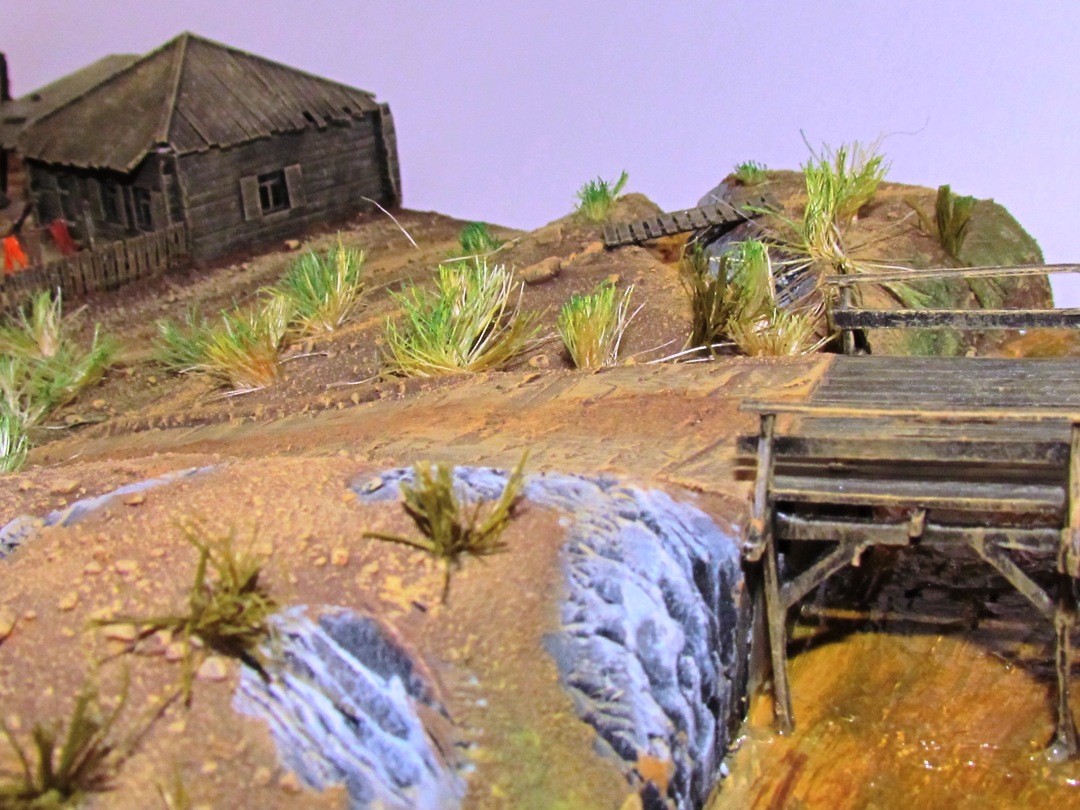
A terrain feature, with a bridge and a small creek


Check out the muddy water under this bridge.


My guess is that this could turn out to be a perfect spot for some light infantry skirmishing.

Another great piece of artwork ML!

Now ML and CB are tied up one again in the current competition to measure the best modelling output in town.

By the way, JMM has also been given some points with all the work he put out related to the Pendraken competition. Come on JMM, you are not going to give up now, are you?

Keep it up and you might be able to leave ML and CB behind !


BT

segunda-feira, 5 de março de 2012

Spanish Civil War & Locomotives - by Carlos Briz


(Class 4021 locomotive - Madrid-Zaragoza-Alicante Railways)

CB brings us back to the Iberian Peninsula and to one of the worst civil wars of the XX century!

Here we have a Republican deposit of hardware, ready to be transported by train to the front lines.

The Trubia Naval was a light infantry tank of Spanish origin, based on the French Renault F-17. 

A tank crew considered itself fortunate when there was none of these vehicles available to fight with...


(Class 4021 locomotive - Madrid-Zaragoza-Alicante Railways)

And now, of course, a similar harware deposit, this time on the Nationalist side.

The average quality of Nationalist hardware was superior to that of the Republicans, even if sometimes there was a perfect mix in material used by both sides.

Nevertheless, stuff "made in Germany" made all the difference even then...


Great job CB!


BT

sexta-feira, 24 de fevereiro de 2012

Locomotives & War (Vietnam) - by Carlos Briz


(Class GP 20 locomotive - U.S. Army Transportation Corps)

Good morning Vietnam!

CB brings us another outstanding king-size dio, this time related to the Vietnam War.

That fine Douglas AC-47 gunship over there (aka Spooky, to his friends) brought something new to the modern battlefield, when air superiority was possible. 

This slow moving World War II vintage aircraft provided the possibility of delivering accurate fire with heavy weapons in direct support of ground troops, blunting many Vietcong offensives.

One of measures of the sucess of this particular weapon was the Presidential Unit Citation given in 1968 to the 14th Air Comando Wing, where two squadrons of  AC-47's served.


BT
quarta-feira, 22 de fevereiro de 2012

Italian Camel Troops - Meharisti in WW2 (Pendraken Painting Competition)


The Italian (like other colonial countries) in their respective North African territioire (Cyrenaica and Tripolitania) locally recruited camel corps.

The Italian Camel Corps was considered very effective. It was officially called Meharists, after the Mehara camel it used. Camel-mounted troops were mainly employed by the Saharan Command for desert patrol purposes, however attached to his armored group General Bergonzoli, XXXIII Army Corps (September 1940), had a Saharia Libyan troop comand. The units were composed of libyans and included a Saharian batallion, a Camel battery of 65/17 guns.


Since there are not specific models for creating a meharisti ww2 troops, I´ve used and adapted the colonial Pendraken range, some ww2 Italian officers and some Pithead models for my artillery.


I´ve used some of the models below (from pendraken (10mm) to participate in the Pendraken Painting Competition 2012.


Camel troops with italian officer (riding in the middle)


Meharisti with their transport (camels)


 Camel battery of 65/17 guns (Pithead and Pendraken)
Best Regards JMM

segunda-feira, 20 de fevereiro de 2012

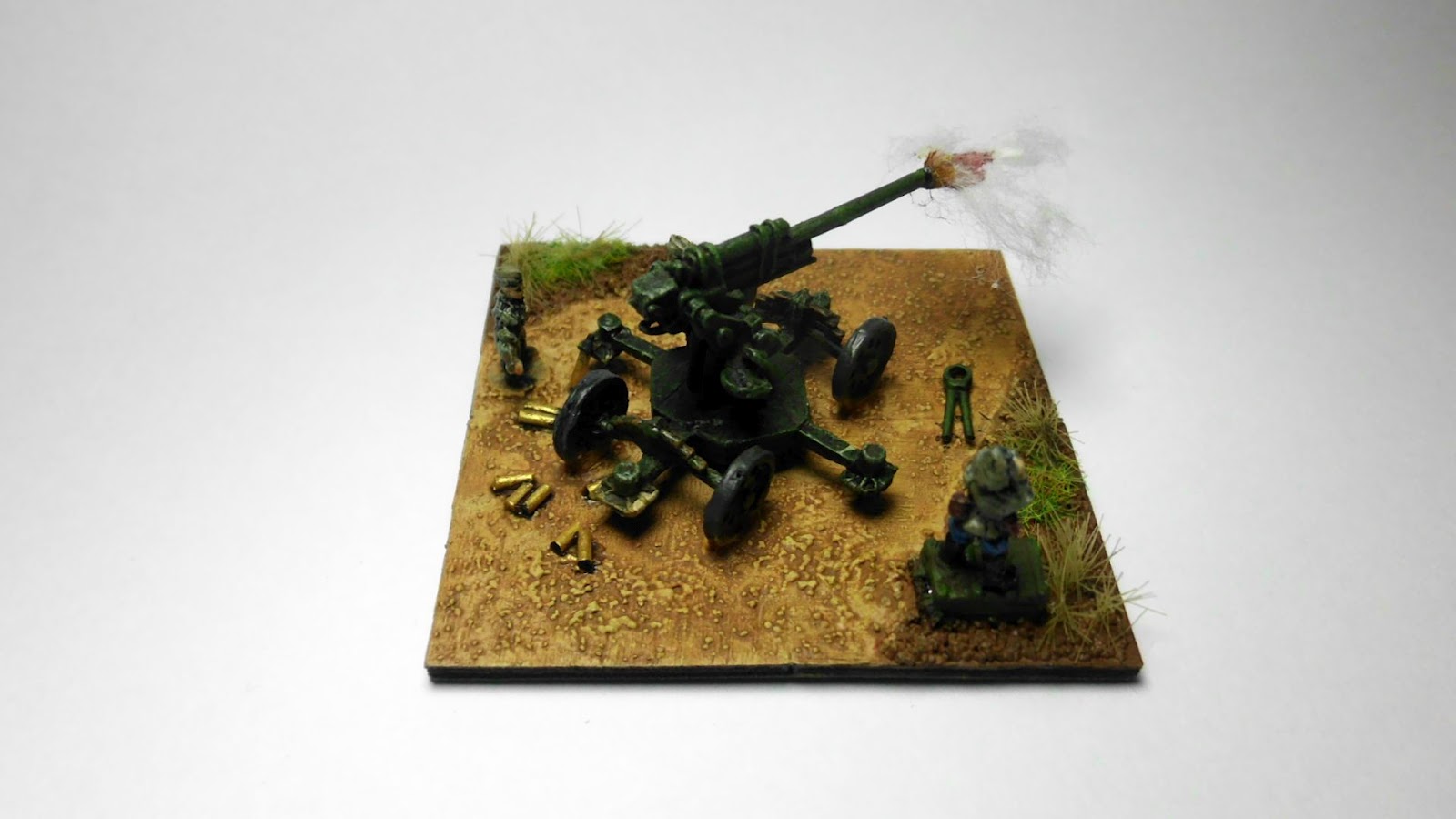
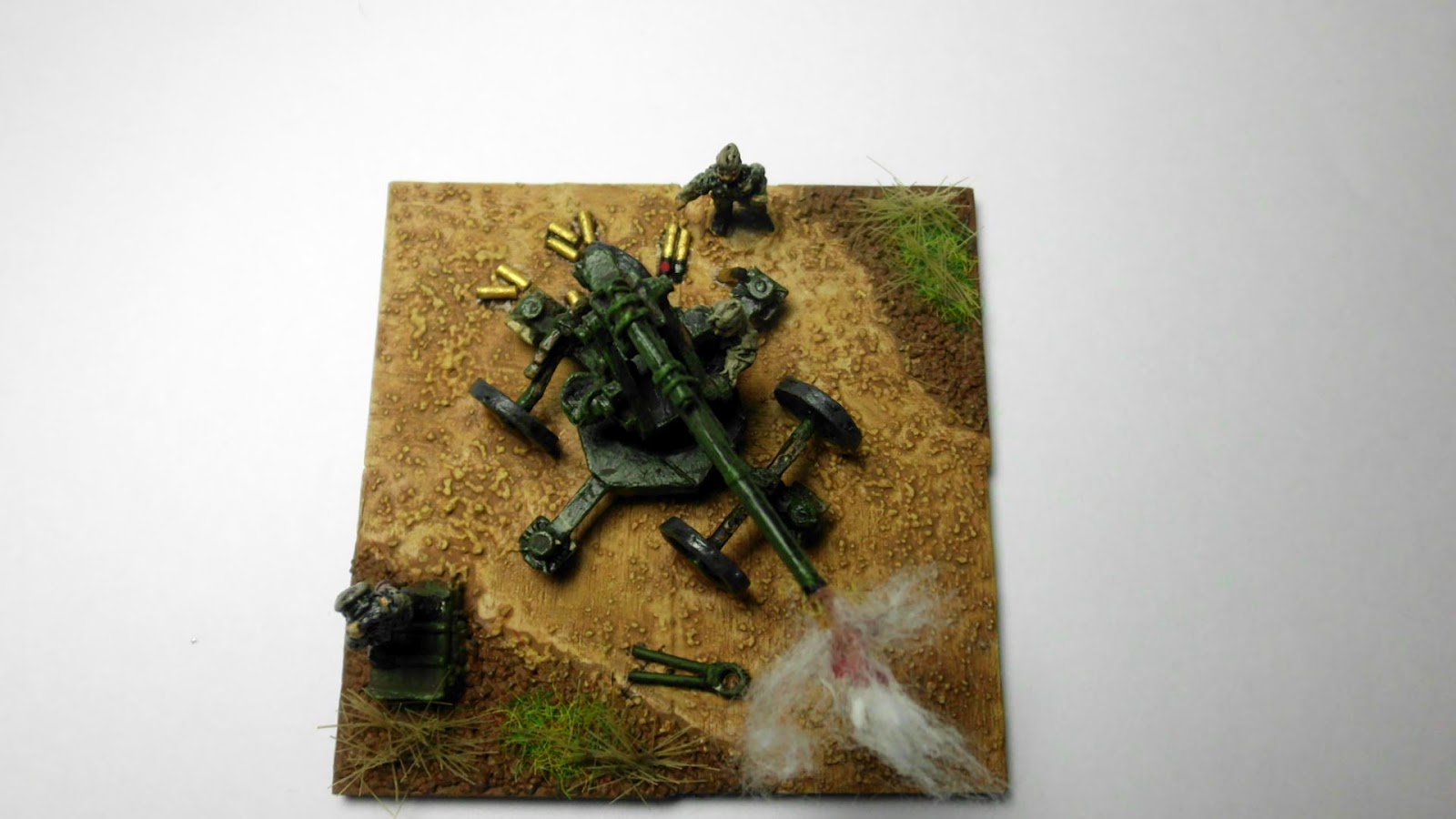
76 mm AA - Model 1931/38 (Pendraken Painting Competition)

The Soviets used the 76 mm model 1931 and model 1938 mainly for air defense purposes. Model 1931 has been credited as design of G. P. Tagunov, the improved version called model 1938 was created by the Soviet artillery designer M N Loginov. The main difference between the two models was the introduction of a new driving device and some smaller improvements.
During World War 2 both of these guns saw a lot of use with Soviet military.
The Germans also captured these guns in large numbers and armed large number of their anti-aircraft gun units in air-defence of home front with them. German names for these guns were 7.62 cm Flak M 31 (r) and 7.62 cm Flak M 38 (r), after running out of captured ammunition Germans modified the guns to 88-mm calibre. In that new calibre these guns were known as 7.62/8.8 cm Flak M 31 (r) and 7.62/8.8 cm Flak M 31 (r).
In some cases the Russians used them as AT weapons, the gun had a hitting penetration of 78mm at 500 meters and 68 mm at 1000 meters.
The Finish (who captured about forty guns and also bought some more from the Germans) developed an AT round that increased the hitting penetration. Until the introduction of the 7.5 cm Pak 40, in May of 1943, these anti-aircraft guns were the most powerful antitank-weapons in Finnish inventory.  (http://www.jaegerplatoon.net/AA_GUNS3.htm)The model below is from pendraken (10mm). It belongs to my soviet army and I used it to participate in the Pendraken Painting Competition 2012.


Best Regards
JMM

quinta-feira, 16 de fevereiro de 2012

T -28 SOVIET TANK (Pendraken Painting Competition) - by JMM


The T-28 was a Soviet medium tank. It was an infantry-support tank intended to break through fortified defences. The prototype was completed in 1931 and production began in late 1932. The tank was deployed during the Invasion of Poland and the Winter War against Finland. 

When the germans invaded URSS, in June 1941, the Soviets had 411 T-28 tanks, however, during the first two months of the invasion,  most T-28s were lost, many of them abandoned after mechanical breakdown. After, late 1941, they were rare in Red Army service, only a few were operated by enemy forces (like Finland).

The model below is from pendraken (10mm). It belongs to my soviet army and I used it to participate in the Pendraken Painting Competition 2012.


I decided not to include any markings or symbols so that  I may double use it also with my Finns.

Best Regards
JMM

quarta-feira, 15 de fevereiro de 2012

Scratchbuilt wargames terrain - by Mário Laranja (Part 1)


And now ML is making a few more contributions to the world wide addiction of wargamers: 

Wargames terrain!
(1/144 scale)

The first pic reveals the quality of the material used by ML.

The bridge is so well built that it can even take on a Panther!


The Panther was not made to stand in a dug out and wait for enemy armour to arrive.

There must be only one explanation for this: hundreds of roaming T-34's!


And now you can see how a Panther deals with a threat of hundreds of roaming Shermans.

It places itself on the top of a hill in order to have a better field of fire...


After a great post placed by JMM, related to his Tachanka, ML bring us yet another great example of his artwork with this outstanding wargames material.

My guess is that in the tournament we have sheduled for September in Espinho we will only have time to check out all the goodies lying around in the wargames tables.

BT